Anion Gap Calculator for Delta-Delta Interpretation
What Is the anion gap?
The https://rentry.co/94gzp3qf anion gap is an derived value used to measure acid-base balance by contrasting major measured ions in a serum chemistry or electrolyte panel. An Anion Gap Calculator helps clinicians and learners quickly estimate whether there is an unexpected amount of hidden acids in the blood. At its core, the calculation uses serum sodium, serum chloride, and serum bicarbonate to assess the relationship between positive ions and anions.
The principle is easy: the body keeps charge balance, so the positive and negative charges in blood must offset each other. Because not every ion is directly measured, the anion concentration is inferred from routine laboratory values. A shift in this balance can point toward a metabolic issue, especially metabolic acidosis. In clinical practice, the anion gap is a quick diagnostic tool for narrowing the cause of an acid-base disorder.
Most providers review the anion gap alongside the chloride level, sodium level, and bicarbonate level, then interpret the result in the context of symptoms, medications, and blood gas findings. That broader assessment matters because the anion gap alone does not tell the full story. It is one piece of blood gas interpretation and should be considered with respiratory compensation and the patient’s overall condition.
How the Anion Gap Calculator Functions
The traditional anion gap formula is:
Anion gap = serum sodium − (serum chloride + serum bicarbonate)This calculation measures the amount of undetected anions in the blood. When sodium is compared with chloride and bicarbonate, the resulting gap indicates substances such as proteins, phosphates, sulfates, lactate, and ketones that are not listed directly in the basic panel.
A standard reference range changes by laboratory because methods and instruments differ. That is why clinicians should always interpret the number using the local reference interval rather than relying on a single universal cutoff. The specific reporting method also affects whether potassium is included; most modern calculators omit it for simplicity and consistency.
Many modern calculators also support albumin correction. Albumin is a negatively charged protein and is a major unmeasured anion. If albumin is low, the measured anion gap may appear falsely normal. A corrected anion gap compensates for this by applying a correction factor based on the albumin level, improving clinical accuracy in patients with low protein states.
The result of the calculator is not just a number. It is an initial step for deciding whether the patient likely has high anion gap metabolic acidosis, another type of acid-base disorder, or a mixed pattern. The best interpretation comes from combining the anion gap with bicarbonate level, pH, and the rest of the serum chemistry.
What Is Delta-Delta Analysis?
Delta delta analysis helps to determine whether a patient with a high anion gap also has an additional acid-base disturbance. This approach compares the change in the anion gap to the change in bicarbonate. It helps reveal a mixed acid-base disorder rather than assuming that all abnormalities are explained by a single cause.
In a typical case of metabolic acidosis with elevated anions, the extra acid consumes bicarbonate in roughly equal proportion to the rise in unmeasured anions. If the bicarbonate has fallen more than expected, there may be a second disturbance such as normal anion gap metabolic acidosis. If the bicarbonate has fallen less than expected, a concurrent alkalinizing process such as metabolic alkalosis may be present.
This is where delta gap and delta ratio become helpful. The delta gap compares the increase in anion gap to the decrease in bicarbonate. The delta ratio shows that relationship numerically, giving an efficient way to screen for mixed disorders. In practical terms, delta delta helps answer a key question: is the patient’s acid-base pattern explained by a single disturbance, or is more than one problem occurring at once?
Blood gas data often adds important context. Blood gas interpretation can show whether respiratory compensation is appropriate, inadequate, or excessive. That matters because a patient with metabolic acidosis may also have a respiratory process affecting pH, which changes the overall picture.
Understanding Delta-Delta Results
To interpret delta delta properly, begin by determining whether the patient has a elevated anion gap process. Then contrast the rise in gap with the drop in bicarbonate. The most basic clinical pattern uses the concept of expected bicarbonate. If the bicarbonate is similar to what would be predicted from the rise in anion gap, the disturbance may be a pure high anion gap metabolic acidosis. If not, a different process should be considered.
This is the approach used in many bedside assessments:
- If the delta gap is around zero, the relationship between anion gap and bicarbonate is even.
- If bicarbonate is lower than the expected bicarbonate, suspect an added normal anion gap metabolic acidosis.
- If bicarbonate is higher than expected, think about concurrent metabolic alkalosis or chronic compensation.
In practice, the delta ratio is often used as a shortcut. A decreased ratio suggests that bicarbonate has fallen more than expected for the degree of gap elevation, which supports a mixed picture with non-gap acidosis. A elevated ratio suggests reduced bicarbonate loss than expected, which may indicate alkalosis layered on top of a high-gap process.
These findings are especially important because a patient can have normal anion gap metabolic acidosis and high anion gap metabolic acidosis at the same time. The result may look less dramatic on a single lab printout, yet the underlying acid-base disorder is more complex. Delta delta clarifies the interpretation and improves clinical decision-making.
Detailed Step-by-Step Illustrative Calculation
Here is a worked example that shows how an Anion Gap Calculator and delta-delta analysis can be used together.
Step 1: Review the laboratory values. Assume the patient has:
- Sodium: 140
- Chloride level: 100
- Bicarbonate level: 14
- Albumin: low enough to require correction
Step 2: Work out the anion gap. Using the anion gap formula:
140 − (100 + 14) = 26This result is elevated and suggests high-gap metabolic acidosis.
Step 3: Use albumin correction. If albumin is reduced, the measured gap may not fully reflect the true abnormality. After albumin correction, the corrected anion gap may be even higher. This adjustment is especially helpful when the clinical picture suggests a substantial metabolic disturbance but the raw anion gap is near the limit.
Step 4: Calculate the delta anion gap. If the normal baseline gap is 12, the delta anion gap is 26 − 12 = 14.
Step 5: Assess the bicarbonate decrease. If normal bicarbonate is 24, the bicarbonate drop is 24 − 14 = 10.
Step 6: Calculate the delta ratio. Delta ratio = 14 / 10 = 1.4.
Clinical meaning: A ratio around this range often fits a straightforward high-gap metabolic acidosis, without a strong signal for a second major process. However, if the bicarbonate had been much lower than expected, that would suggest an added normal anion gap metabolic acidosis. If the bicarbonate had stayed higher than expected, a concurrent alkalosis would be considered.
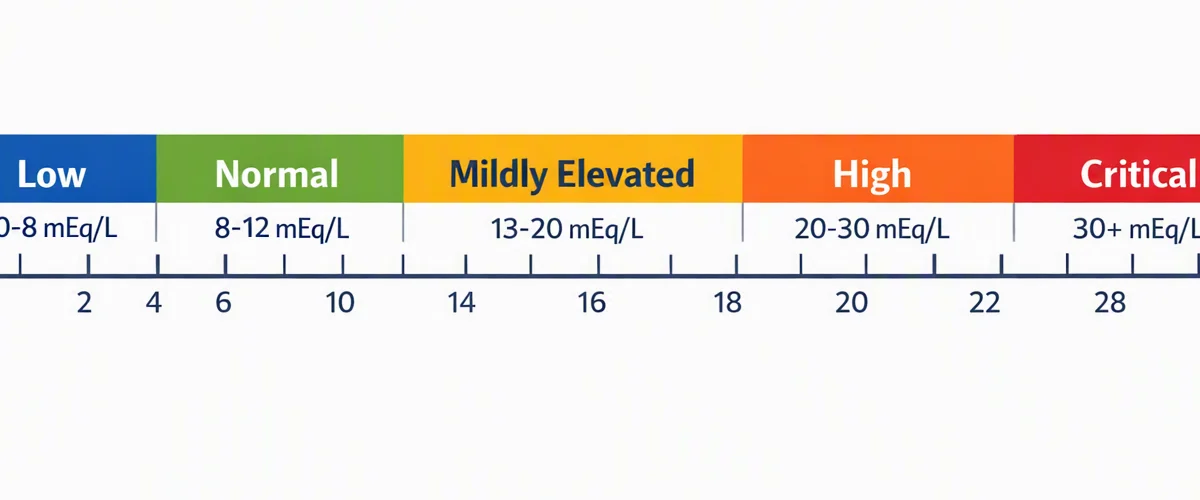
In this way, the sample calculation shows more than a number. It links the corrected anion gap, delta anion gap, and serum bicarbonate into a clinically relevant clinical picture. That is the real value of the calculator: it supports a more nuanced diagnosis rather than a single-label answer.
Typical Causes of an Elevated Anion Gap
Several conditions can cause an elevated gap by raising unmeasured acids in the bloodstream. Common causes include:
- Lactic acidosis, frequently linked to poor tissue perfusion, severe illness, or increased lactate production
- Ketoacidosis, that can arise with diabetes, starvation, or alcohol-related states
- Renal failure, where acid retention and reduced excretion of unmeasured acids raise the gap
- Toxic alcohol ingestion, such as substances that generate acid metabolites and profoundly disturb serum chemistry
These conditions are often classified as high-gap states because they produce a form of metabolic acidosis with accumulation of acids that are not reflected directly in standard lab measurements. A close review of the history, medication list, and blood gas interpretation is essential to differentiate these causes.
As an example, ketoacidosis may present with elevated ketones and profound bicarbonate loss. Lactic acidosis may be seen when the body is under stress and oxygen delivery is impaired. Renal failure can produce progressive acid retention, and toxic alcohol ingestion should always be considered when the clinical setting is suspicious and the acid-base pattern is severe or unexplained.
Constraints and Medical Warnings
Though an Anion Gap Calculator can be helpful, it does not take the place of medical judgment. Multiple factors impact the result and must be reviewed during analysis.
First, albumin correction is important because low albumin can conceal an increased gap. Absent that adjustment, a patient with substantial acid accumulation may appear to have a normal value. Next, lab variation can alter the reference interval from one instrument to another, so always read the number using the local report. Finally, electrolyte abnormalities can skew the apparent balance between sodium, chloride, and bicarbonate, particularly in complicated hospitalized patients.
The anion gap also reflects only one part of acid-base balance. A patient can have a near-normal gap and still have a clinically meaningful disorder. Similarly, respiratory processes can change pH even when the metabolic component is only somewhat abnormal. That is why the calculator should be used together with blood gas interpretation, symptom review, and other laboratory values.
It is also worth noting that a single snapshot does not always show the whole story. Trends in serum sodium, serum chloride, and serum bicarbonate may be more useful than one isolated draw. In clinical practice, the best use of this tool is to support recognizing patterns, not to replace broader diagnostic reasoning.
FAQ
What does an Anion Gap Calculator measure?
An anion gap calculator calculates the discrepancy between recorded cations and anions, usually using serum sodium, serum chloride, and serum bicarbonate. It approximates the level of unmeasured anions and helps identify metabolic acidosis and related acid-base disorders.
How do you work out delta delta for anion gap interpretation?
Delta delta contrasts the rise in the anion gap to the fall in bicarbonate. First subtracting the normal anion gap from the measured value to get the delta anion gap, then compare that number with the drop in bicarbonate from normal. The result helps determine whether there is a mixed disorder.
When is albumin correction needed?
Albumin correction should be used when serum albumin is low, because albumin is a major unmeasured anion. Without correction, the corrected anion gap may be miscalculated and a clinically important high-gap state may be missed.
What does a high delta delta ratio mean?
A high delta ratio usually means the rise in anion gap is greater than the fall in bicarbonate, which can suggest concurrent metabolic alkalosis or another process that is offsetting the expected bicarbonate loss. It is a clue that the patient may have a mixed acid-base disorder.
Can a normal anion gap happen in a mixed acid-base disorder?
Yes. A patient may have a normal measured gap and still have a mixed acid-base disorder, especially if one process raises the gap while another lowers it, or if the gap is masked by hypoalbuminemia. That is why blood gas interpretation, albumin correction, and the full clinical context matter.